
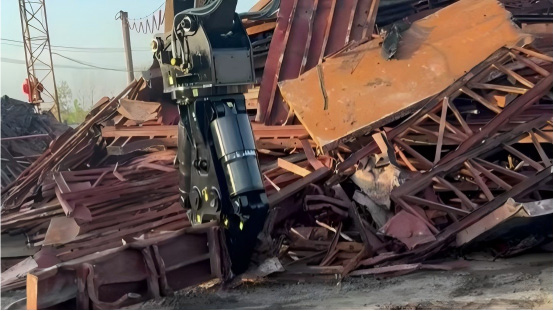
Hydraulic Shears The New Demolition Tools.Industry analysts see a clear shift: low‑carbon demolition, electric excavator compatibility, and smart attachments are making Hydraulic Shears The New Demolition Tools.
Across major construction markets, a quiet revolution is underway. The familiar roar of diesel‑powered torches and the percussive hammering of hydraulic breakers are being phased out—not by fiat alone, but by economics, regulation, and technology. In their place, the hydraulic shear has emerged as the attachment of choice for forward‑thinking contractors and rental fleets.
New Regulations: The End of “Business as Usual”
Two regulatory waves are reshaping demolition sites in 2026.
1. Restrictions on diesel‑powered torches and oxy‑fuel cutting.
Several EU member states and North American air districts now classify torch cutting as a high‑emission activity. Diesel‑driven mobile torch rigs face particulate matter limits that older units cannot meet. Meanwhile, oxy‑acetylene cutting generates carbon monoxide, nitrogen oxides, and noise—all increasingly regulated under urban low‑emission zones.
2. Noise ordinances targeting hydraulic breakers.
Breakers operating above 105 dB are banned from nighttime work in more than 200 cities globally. Daytime permits now require costly sound barriers and real‑time monitoring. For many contractors, the administrative burden alone has made breakers uneconomical for steel‑intensive demolition.
Hydraulic shears operate at 85–92 dB—well within typical limits. They produce no combustion emissions, no slag, and no hazardous fumes. In regulatory terms, they are the clean path forward.
Alignment with LEED, EU Demolition Standards, and Green Building Recycling
Sustainability certifications are no longer optional for large projects. LEED v4.1 awards credits for construction waste management, specifically for diverting metal scrap from landfills and maximizing recycled content. Hydraulic shears produce clean, uncontaminated #1 HMS scrap, which mills can immediately remelt. Torch‑cut scrap, contaminated with slag and scale, often ends up downgraded or rejected.
The EU Demolition Protocol (adopted in updated form for 2025–2026) mandates selective dismantling and high‑purity material streams. Hydraulic shears enable true green building recycling by separating steel from concrete without fusing the two. A shear can cut around embedded rebar, leaving clean concrete for crushing and clean steel for direct resale. Torches and breakers mix materials, creating low‑grade aggregate that fails EU purity thresholds.
For contractors pursuing BREEAM or DGNB certifications, switching to shears is one of the fastest ways to earn waste‑management points.
Electric Excavator Compatibility: The Silent Partner
The rise of battery‑electric and cable‑electric excavators (30–50 ton class) is accelerating the shear trend. Electric excavators deliver instant, high torque—perfect for hydraulic shears—but struggle with breakers. Breakers require high‑pressure pulses that drain battery packs rapidly and generate heat that electric cooling systems cannot dissipate.
Shears, by contrast, draw steady, predictable flow. Early field tests of electric excavators paired with shears show 30% longer runtime per charge compared to breaker operation. Major OEMs now list shear compatibility as a selling point for their electric models. Contractors preparing for 2030 emission bans are already building electric‑first fleets, and shears are the natural attachment partner.
Smart Attachments: Telematics and Predictive Maintenance
The attachment itself is becoming a data node. Smart attachments with embedded sensors are entering the market. Hydraulic shears lead this trend because their cutting cycle is easily measured.
Predictions for 2026–2027:
Cut counting – Telematics modules will record every full closure, tracking total cuts against blade life. When a preset threshold (e.g., 8,000 cuts) is reached, the system alerts the operator to rotate blades.
Blade wear sensors – Non‑contact proximity sensors will measure blade gap in real time. As clearance increases, the cab display shows a warning: “Adjust clearance now.”
Hydraulic oil condition monitoring – Integrated sensors will detect ferrous particles, water content, and viscosity, predicting seal failures before they happen.
Rental companies are particularly interested: smart shears allow usage‑based billing and remote asset monitoring. A shear that reports its own health reduces downtime and extends residual value.
Emission Regulations: The Countdown Has Started
By 2028, the EU’s Stage V emissions standards will extend to non‑road mobile machinery auxiliary functions—effectively regulating torch rigs and breaker power packs. California’s CARB is drafting similar rules. Contractors still relying on traditional tools face a compliance cliff.
Hydraulic shears, with no exhaust stream and minimal hydraulic leakage risk, are already compliant. For fleet owners, the question is no longer “if” but “when” to transition.
The Bottom Line: Upgrade Now or Pay Later
Early adopters are seeing lower operating costs, higher scrap revenue, and faster project approvals. Those who wait risk being locked out of regulated zones, paying premium rates for dwindling torch crews, and losing bids to greener competitors.
Upgrade your fleet now – ask about the trade‑in program. Many attachment manufacturers offer credits for old breakers, torch rigs, or obsolete shears. Converting a single 30‑ton excavator from breaker to shear typically pays back in under 500 operating hours, factoring in fuel savings, reduced labour, and higher scrap value.
The trend is clear. Hydraulic shears are not just an alternative—they are the new baseline for demolition in a low‑carbon, high‑regulation era.