
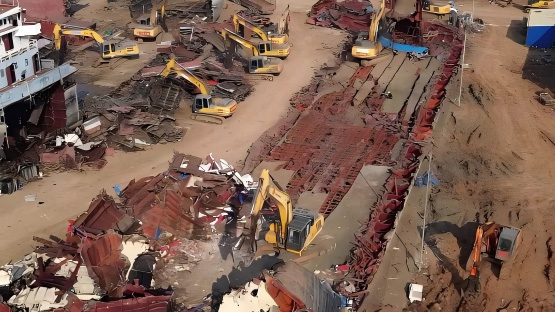
Hydraulic Shears Outperform Oxy-Acetylene Cutting.You walk into scrap yards every week and see the same profit leak: rows of torch cutters hunched over smoking steel, waiting for preheat, dragging hoses, and grinding off slag. Then you show the owner a hydraulic shear in action. Their eyes widen. Not because it’s flashy—because they just realized how much money they’ve been burning.
If you’re still using oxy‑acetylene to size your scrap, you’re not recycling metal. You’re burning cash.
The Hidden Costs of Torch Cutting (Most Owners Ignore)
Let’s break down the true cost per cut with oxy‑fuel. It’s never just the gas.
Gas consumption – Oxygen and acetylene (or propane) run $12–$18 per hour per torch. A two‑torch crew burns $30/hour before they cut a single piece.
Labour inefficiency – A torch operator spends 60% of their time preheating, repositioning, and cleaning. Only 40% is actual cutting.
Slag cleaning – Torch cuts leave a hard, glassy oxide layer (slag). You pay a labourer $20/hour to grind or chip it off. If you don’t, your downstream shredder or baler wears out 3x faster.
Safety & compliance – Hot work permits, fire watches, flashback arrestors, ventilation. One torch‑caused fire can shut your yard for a week.
Material loss – The kerf (gap) of an oxy torch is 2–4 mm of vaporized steel. Over 10,000 cuts, that’s literal tons of metal turned into rusty dust.
Real‑World Example: Cutting 10mm Mild Steel Plate
I timed both methods on identical material last month at a Midwest yard.
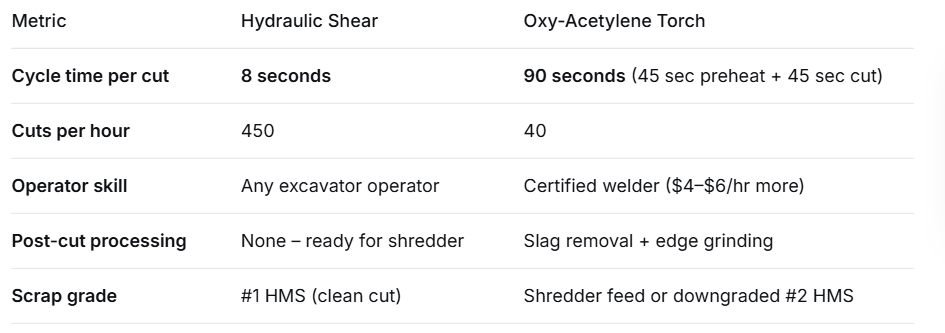
The math: One shear does the work of 11 torch cutters (450 cuts/hr ÷ 40 cuts/hr). But you don’t need 11 torches – you need one shear and one excavator.
Clean Cut Scrap Premium: The $100/Ton Difference
This is where most yards lose their biggest profit. Clean cut scrap premium is real.
#1 HMS (hydraulic shear cut) – No slag, no torch scale, consistent length. Mills pay $40–$60/ton more than standard #2 HMS.
Torch‑cut scrap – Slag inclusions, oxidized edges, variable lengths. Yards discount it heavily because it damages furnace roofs and increases slag volume in the melt.
On a 5,000‑ton monthly throughput, switching from torch to shear adds $200,000–$300,000 per month in top‑line revenue. That’s not a typo.
Manpower Reduction: The 2,000‑Hour Calculation
Let’s calculate labour savings over a single 2,000‑hour work year (one full‑time equivalent).
Torch crew (typical yard):
4 torch cutters @ $28/hr (incl. benefits) = $112/hr
2 labourers for slag removal @ $22/hr = $44/hr
Total direct labour = $156/hr
Hydraulic shear crew:
1 excavator operator @ $35/hr = $35/hr
1 spotter / material handler @ $22/hr = $22/hr
Total direct labour = $57/hr
Hourly labour savings = $99/hr
Annual labour savings (2,000 hrs) = $198,000
Add gas savings: 4 torches burning $15/hr each = $60/hr × 2,000 hrs = $120,000/year.
Total annual operating savings (labour + gas) = $318,000 – before you even factor in the higher scrap price.
Payback Period: Shorter Than You Think
A high‑quality hydraulic shear for a 20–30 ton excavator costs $55,000–$90,000. Installation and hoses add ~$5,000.
Using the $318,000/year savings above:
Payback period = $80,000 ÷ $318,000 = 0.25 years = 3 months
Even if you only run one shift, your payback is under 8 months. After that, every dollar goes straight to your bottom line.
Why Scrap Processing Speed Wins Every Time
Speed isn’t just about cutting faster. It’s about throughput. A yard that processes 40 tons per day with torches can process 200+ tons per day with a shear – without adding acreage, without hiring more people, without fighting city noise ordinances.
Faster processing means:
Lower inventory carrying cost
Quicker turnover to mills
Ability to bid on larger demolition contracts
Fewer rejected loads due to slag contamination
Your Next Step: Stop Burning, Start Shearing
You already know torch cutting is slow. But until you see the numbers side‑by‑side, it’s easy to rationalize “that’s how we’ve always done it.”
I don’t sell shears. I sell productivity. My only job is to walk your yard, time your current torch operation, and calculate exactly how much you’re leaving on the table.