How To Perfectly Match Hydraulic Shear to Excavator Tonnage.I’ve seen it too many times: a contractor buys a “bargain” shear, mounts it on a 20-ton excavator, and within a week the machine is overheating, the blades are chipped, and the cycle time is slower than a torch crew. The problem isn’t the shear—it’s the match.
Undersizing a hydraulic shear is the fastest way to destroy your excavator’s hydraulic system and lose money on every cut. Let me show you how to get it right the first time.
What Happens When the Shear Is Too Small for Your Excavator?
You might think a smaller shear is lighter and easier to handle. Wrong. Here’s the reality:
Slow cycle times – The shear’s cylinder is too small to use your excavator’s full hydraulic flow. You wait 6–8 seconds for a cut that should take 2 seconds.
Poor cut quality – The blades lack closing force. Instead of a clean snap, the shear tears and bends the steel, leaving jagged edges that downgrade your scrap.
Overheating – Your excavator’s pump pushes high flow into a small shear’s relief valve. That excess energy turns into heat. Within an hour, your oil temp hits 90°C and the machine goes into limp mode.
Structural failure – The shear’s housing isn’t designed for the breakout forces of a larger carrier. You’ll crack the pivot pin bosses or bend the lower jaw.
Conversely, an oversized shear is equally dangerous: it demands more hydraulic flow than your excavator can provide, resulting in a “lazy” cutter that stalls on thick material.
The Simple Formula: Matching Shear Force to Material Thickness
Stop guessing. Use this field-proven rule of thumb for structural steel (A36, S235, or similar):
Required cutting force (tons) = Material thickness (mm) × Material width (mm) × 0.7
(For round bar or rebar, use diameter × diameter × 0.4)
Example: Cutting a 10mm thick, 200mm wide I-beam flange.
10 × 200 × 0.7 = 1,400 tons of required cutting force.
Now check your shear’s cutting force chart (usually published by the manufacturer at the blade tip and at mid-jaw). If the shear only delivers 1,200 tons at mid-jaw, you’ll struggle.
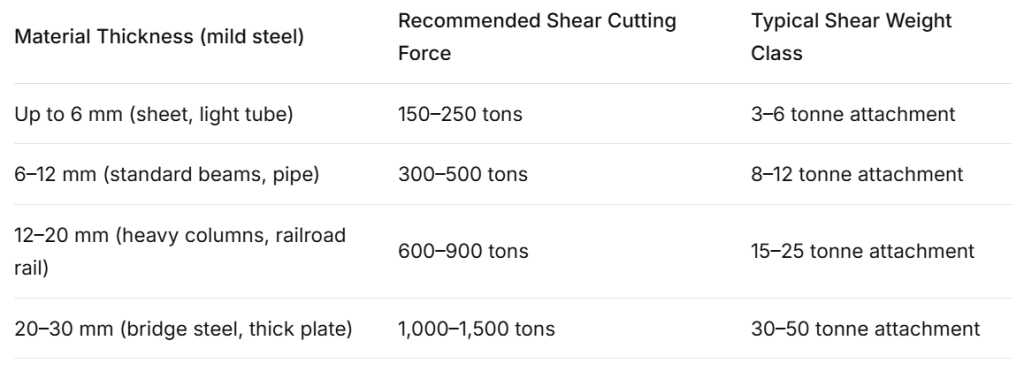
Quick Reference: Material Thickness vs. Minimum Shear Class
Example Matches: Excavator Weight vs. Shear Class
Based on required hydraulic flow (liters/minute) and operating weight, here’s my standard matching guide:
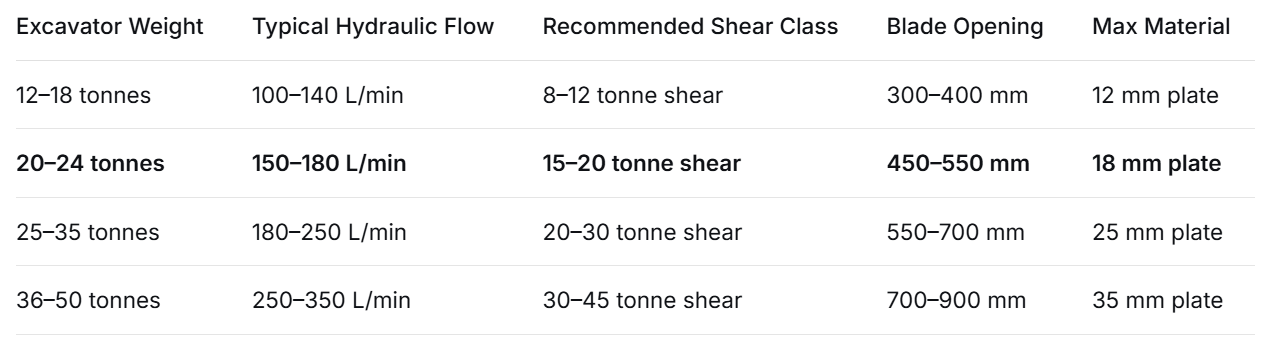
Key check: Never exceed 85% of your excavator’s maximum hydraulic flow when running the shear. Leave 15% for simultaneous slew and arm movement.
Safety-Focused Advice: Undersizing = Danger
An undersized shear doesn’t just hurt production—it creates hazards. When the shear fails to cut through a section, operators instinctively crowd the arm or swing aggressively to “tear” the steel. This sends unpredictable forces through the boom and can snap the attachment bracket. I’ve seen undersized shears fly off excavators, narrowly missing ground crews.
Get It Right – Free Match Report
Every excavator is different. Pump flow, relief pressure, and auxiliary circuit cooling vary widely between brands (Komatsu, Cat, Hitachi, Deere, Volvo). I can’t give you a perfect match without your machine’s specs.
Send me your excavator model, year, and hydraulic flow (if known) – I’ll run our internal shear cutting force chart against your machine and email you a free, no-obligation match report. We’ll tell you:
The smallest shear that safely works
The largest shear your hydraulics can drive
The exact blade life you can expect for your typical material
Perfectly Match Hydraulic Shear to Excavator Tonnage
👉 Email your excavator specs to sales@xamachparts.com with subject line “Shear Match Request” – or use the form on our website.
Don’t guess. Don’t undersize. Cut clean, cut fast, and keep your crew safe.