
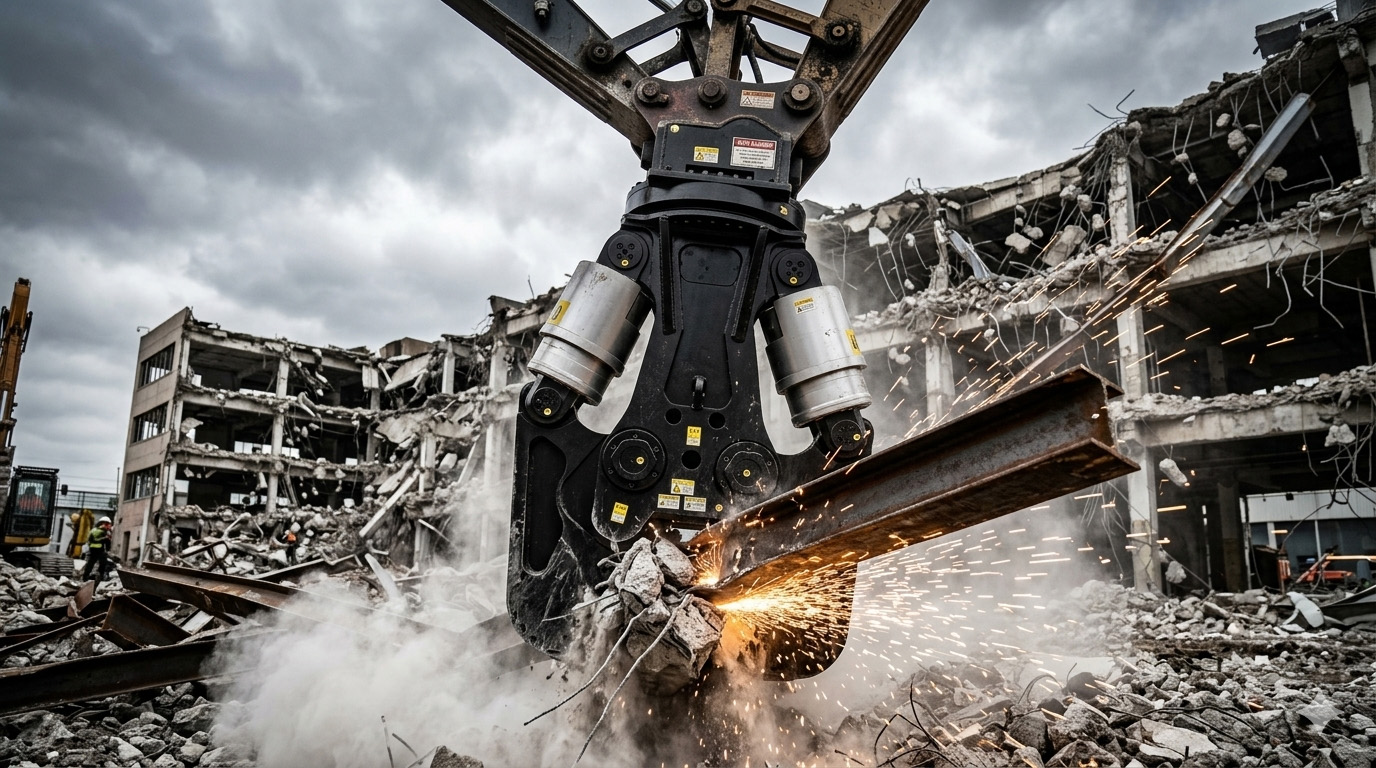
Hydraulic Shear for Steel Structure Demolition. A client needed an old 30‑meter span steel workshop cleared for a new logistics hub. The building was a classic: H‑beam columns every 6 meters, lattice roof trusses, and decades of grime. His previous contractor quoted two days with torches and a breaker. I told him we’d be done by lunch.
He laughed. Then he watched the clock.
Here’s exactly how we took down that 2,000 m² workshop in three hours – safely, dust‑free, and with zero hot work permits.
The Scene: A Tired Workshop, a Tight Window
Dimensions: 30 m span × 60 m length × 8 m eaves height
Structure: Primary H‑beams (200 mm × 200 mm, 8 mm web), cold‑formed purlins, cross bracing
Constraints: Adjacent live factory 5 meters away; no flame or spark allowed; hard clay ground
We mobilized one 30‑ton excavator fitted with a 1,200‑ton hydraulic shear, plus a spotter on the ground. No torch crew. No breaker. No fire watch.
Step‑by‑Step: The Hydraulic Shear Method in Action
Step 1 – Pre‑Cut & Roof Purlin Strip (0:00 – 0:45 hours)
The excavator approached from the gable end. First rule of H‑beam dismantling: never cut a column before you relieve the roof load.
We reached up and snipped the Z‑shaped roof purlins one by one – 8 seconds per cut. They dropped harmlessly between the bays.
Next, we cut the fly braces and horizontal bracing. The shear’s narrow jaw reached into tight corners that a torch never could.
Result: The roof membrane (old fiber cement) stayed intact, but without purlins, the sheeting began to sag. No dust – dust‑free cutting because there’s no grinding or oxygen lance.
Step 2 – Progressive Column Reduction (0:45 – 1:30 hours)
With the roof load gone, we started on the H‑beam columns. Progressive demolition means working from the outside in, never standing under an unsupported member.
We cut each column at 1.5 meters above floor level – high enough to keep the excavator tracks clear, low enough to maintain stability.
The shear made a clean snap through the 8 mm web and flanges. No sparks, no slag, no preheat.
As each column was severed, the excavator nudged the top section inward. The upper frame collapsed in a controlled domino effect.
Step 3 – Floor‑Level Cut & Loadout (1:30 – 2:45 hours)
Now the workshop was a field of fallen H‑beams and trusses. Time to size for the scrap yard.
We pinned each beam with the track, then cut it into 1.5‑meter lengths – perfect for the magnet crane later.
The hydraulic shear method produced clean, torch‑free ends. Every piece went straight into #1 HMS scrap.
Step 4 – Final Cleanup & Column Stumps (2:45 – 3:00 hours)
The last 15 minutes: we cut the remaining column stubs flush to the concrete floor. The shear’s rotating jaw angled down easily. No grinder, no hot work sign‑off.
Job done. Three hours on the dot.
Time Comparison: 3 Hours vs. 2 Days

The torch estimate assumed 90 seconds per cut. We averaged 8 seconds. Even accounting for repositioning, we were 12x faster.
Safety Gains: Why I’ll Never Go Back to Hot Work
Operator safety isn’t just a checkbox – it’s why my crew goes home whole.
No hot work means zero fire risk. The adjacent factory didn’t even stop production. No burn injuries, no explosion hazard from residual fuel tanks or oil residue on the steel.
Less vibration. A breaker shakes the operator’s spine and loosens the excavator pins. The shear’s smooth, slow cut keeps the machine stable. My operator climbed out after three hours without fatigue.
Predictable structural behaviour. Torch cutting heats the steel, causing sudden drops or warping. The shear’s mechanical cut is instant – you know exactly when the piece will fall.
No dust or fumes. Torch cutting galvanized purlins releases zinc oxide fumes (metal fume fever). The shear produces a little rust dust – negligible. Ground crew didn’t need respirators.
The Moment the Client Believed
At 11:00 AM, I called the client. “We’re done. Come see.” He arrived at 11:30 to a flat, clean site. Steel stacked in neat rows. No burn marks. No slag piles. He walked the perimeter, then shook my head and said, “I didn’t think it was possible.”
That’s the thing about Hydraulic Shear for Steel Structure Demolition. Until you see it, you assume hot work is the only way. It’s not. It’s just the old way.
📞 Call me directly: +8615318850214– or email sales@xamachparts.com with “Workshop Demo” in the subject line.
Cut steel, not corners.