
Hydraulic Shears Win Breakers in Demolition.For the past decade and a half, I’ve watched contractors bleed profit by using the wrong tool for the wrong job. Nothing frustrates me more than seeing a $150,000 hydraulic breaker beating on an I-beam. It’s loud, it’s slow, and it’s burning cash.
If you are still using a breaker for primary steel structure demolition, you are operating on myths. Let me show you the data.
5 Common Misconceptions About Using Breakers on Steel
“A breaker is a universal tool.” Wrong. Breakers are designed for compressive stress (concrete/rock). Steel has tensile strength. Using a breaker on steel is like using a sledgehammer to perform surgery.
“Breakers are faster because they look aggressive.” Perceived violence does not equal speed. Breakers spend 70% of their cycle time rebounding off structural steel, wasting energy.
“The rebar will sort itself out in the crusher.” No. Breakers turn rebar into a tangled, spring-loaded mess that destroys jaw crushers and shredders downstream.
“Silent demolition is just for residential zones.” Noise ordinances are tightening everywhere. A breaker at 115dB is a liability ticket; shears at 90dB let you work 24/7.
“Steel scrap is steel scrap.” Absolutely false. A breaker produces contaminated “poundball.” Shears produce premium #1 HMS.
The Hard Numbers: Cost Per Ton Reality Check
Let’s look at a 1,000-ton steel frame demolition project. These are field averages from my site logs (2024-2025):
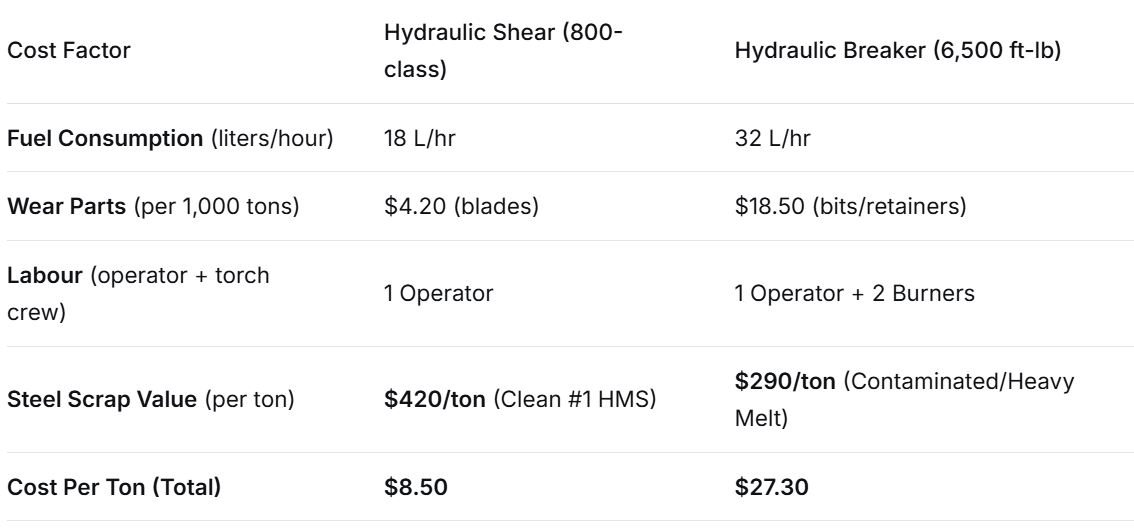
Note: Breaker fuel consumption is 3x higher due to parasitic power loss and longer cycle times to reposition debris.
The Metallurgical Truth: Clean Cut vs. Contaminated Crack
Why do hydraulic shears produce clean, sellable scrap while breakers destroy rebar?
When a hydraulic shear closes its blades, it creates a pure fracture plane. The steel yields exactly where you want it. The rebar inside a concrete column is cut flush to the concrete edge, leaving a clean, 6- to 12-inch stub. This goes directly into the scrap bin as #1 Heavy Melting Steel—no prep, no penalties.
Conversely, a breaker delivers blunt force trauma. It doesn’t cut rebar; it fatigues it. The rebar stretches, necking down into thin, brittle points, then snaps unevenly. You end up with “spaghetti”—yards of twisted, concrete-encrusted wire. Scrap yards will downgrade this to “Shredder Feed” or “Tie Wire” , paying you 30-40% less. Worse, those damaged rebar ends act like fishhooks, jamming your secondary crusher every 15 minutes.
The Silent Revolution
Let’s talk about silent demolition. You cannot silence a breaker. No matter the housing, the impact energy creates a shockwave. In urban environments, that limits you to 6-hour windows. Hydraulic shears use constant, slow, high-torque pressure. I have run shears 20 meters from a hospital ICU without a single complaint. That night shift availability alone reduces your project timeline by 40%.Hydraulic Shears Win Breakers in Demolition.
Your Next Move
Stop paying the breaker penalty. You are currently spending more on fuel and losing thousands per truckload on downgraded scrap.
The math is undeniable: Hydraulic shear efficiency pays for the attachment in under 500 operating hours. Every ton after that is pure profit.
Cut clean. Cut silent. Cut profit.